


National Geographic 1992 June
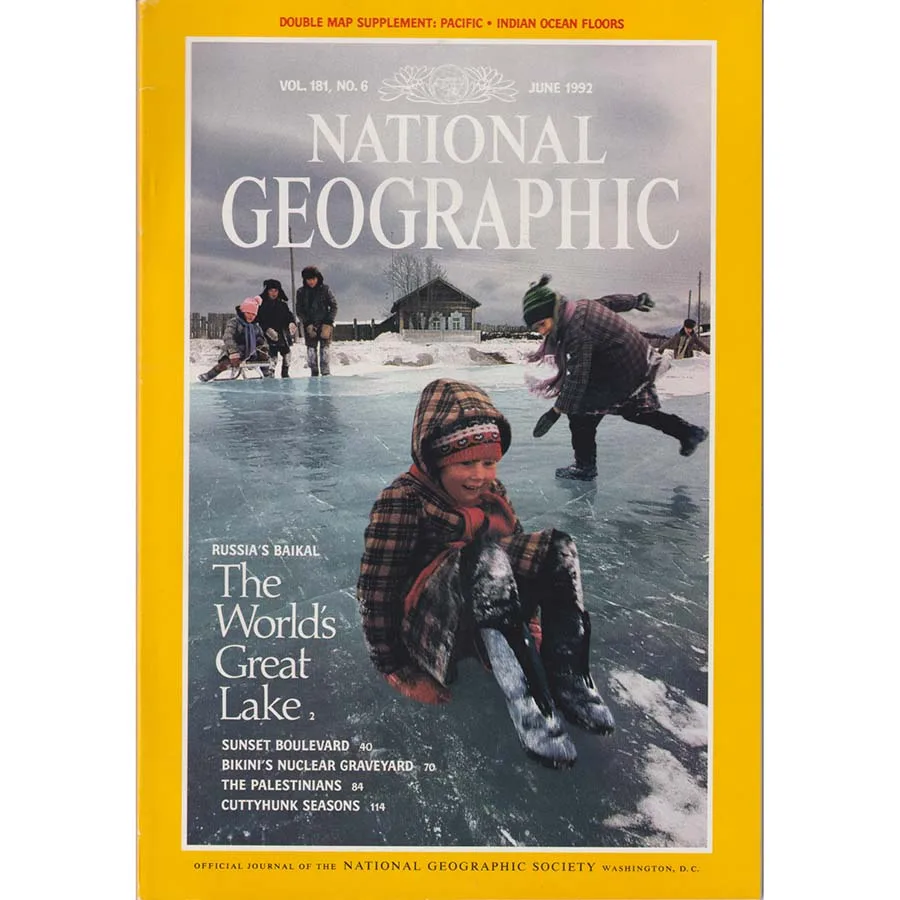
Publisher: National Geographic
Format: Paperback
ISBN: none
National Geographic, June 1992: the issue that kicks open the door, throws a child onto a sheet of ice at high speed, and says, “Welcome to the world. It’s beautiful. It’s freezing. Also, please contemplate nuclear waste and geopolitics before pudding.”
The cover story is Russia’s Baikal: The World’s Great Lake, which is National Geographic code for: “Here is a place so vast, ancient, and quietly intimidating that you will feel personally smaller by page three.” Lake Baikal isn’t just a lake; it’s a geological flex—deep, clear, and old enough to make your own problems look like a brief scheduling error. The cover image nails the vibe perfectly: everyday life playing out on a surface that looks like polished glass, with winter casually turning the landscape into a giant, slippery playground. It’s wholesome, yes—but also faintly terrifying, because that is a long way to slide if you get carried away.
Inside, expect Baikal to be served with the full Nat Geo treatment: stunning photography, ecology, history, and that early-90s undertone of “the world is changing fast.” 1992 Russia is a whole mood—post-Soviet uncertainty, new realities, old landscapes, and communities living alongside a natural wonder that doesn’t care about politics. The lake just is, while humans reorganise everything around it.
And then—because National Geographic is incapable of letting you relax for more than five minutes—the rest of the issue is a brilliantly chaotic spread of topics, like a buffet where someone keeps swapping your plate mid-bite:
-
Sunset Boulevard – glamour, myth-making, and the slightly absurd idea that a street can become a legend. Expect Hollywood sheen with a side of cultural archaeology: how a place sells a dream and then has to live inside it.
-
Bikini’s Nuclear Graveyard – yes, that Bikini. A title that sounds like a dystopian theme park until you remember it’s real. It’s one of those Nat Geo features that starts as history and ends as a long, quiet stare into the consequences of “progress.”
-
The Palestinians – a sober, human-centred look at a subject that refuses to be simple. The kind of reportage National Geographic did with gravity: lives, landscapes, daily realities, and the weight of politics on ordinary people.
-
Cuttyhunk Seasons – and then, mercifully, a breath of salt air and small-scale life. A seasonal portrait that reminds you the world also contains places where the drama is weather, fishing, and time passing in a way that feels almost kind.
And at the very top, like a little bonus for the cartography-obsessed, the banner promises a Double Map Supplement: Pacific / Indian Ocean Floors—which is Nat Geo’s way of saying, “Here, have the bottom of the world on paper.” It’s the sort of fold-out that makes you feel like a marine geologist for ten minutes, and then makes you wrestle with refolding it like you’re fighting a sail in a storm.
Condition: Good, which is perfect for a 1992 issue: sturdy, readable, and still packed with that pre-internet heft—proper articles, proper photography, and no fear of your attention span. Sold by Crappy Old Books, naturally, because only a place with that name would casually hand you Lake Baikal wonder, Hollywood myth, nuclear aftermath, Middle East reality, and island seasons in one satisfying yellow rectangle.
If you like your magazines like your world: breathtaking, complicated, occasionally bleak, and weirdly joyful on a frozen lake—June 1992 is a belter.
Keep browsing: See more National Geographic books Other books by National Geographic
